The No-Drama Guide to Choosing Glasses That Fit
- Match total frame width to your cheekbone width within ±5 mm for an adult, balanced fit.
- Use contrast: strong jaws like softer, rounder frames; round faces like sharper, more angular frames.
- Pick bridge, lens width, and temple length that pass the shake, smile, and red-mark tests.
- Choose matte or satin finishes and anti-reflective lenses to cut photo glare.
- Build a small rotation: a daily neutral, a bold acetate, and a light wire frame for dress.
The quick answer: how to pick glasses that work
You want frames that fit, balance your face, and don’t wreck your photos. Here’s the short version you can use in a store today.
1) Width rule (most important)
- Stand relaxed. Look straight ahead. Note your outer cheekbone points. Pick frames whose total width (hinge-to-hinge end) is roughly equal to that span, within ±5 mm. Too wide looks droopy; too narrow pinches and makes your head look big.
- If the frame’s printed numbers are 52–18–145, a safe total width for many acetates is roughly lens width x 2 + bridge + 6–10 mm for hinges. Example: 52–18 ≈ 128 + 8 ≈ 136 mm total. Ask the shop for the manufacturer’s listed total width if unsure.
2) Shape rule (balance, not copy)
- Balance your dominant lines. Strong, square jaws do well with rounder or oval frames. Softer, round faces do well with angular rectangles or squared aviators.
- Keep lens height proportional. Average daily wear: 35–42 mm lens height. If you need more reading zone in progressives, aim 38–44 mm.
3) Fit rule (bridge and temples)
- The bridge should hug without sliding when you nod. On acetate, a keyhole bridge helps if your nose is narrow at the top. On metal, tune nose pads so the top rim sits just below your brows.
- Temples should touch lightly in front of the ear bend, then curve behind the ear. If they splay out or bite in, you need a different temple length or an adjustment.
4) Color and finish
- Daily neutrals that work on most men: matte charcoal, espresso tortoise, navy, or brushed gunmetal. High-contrast hair/skin can handle darker frames; low-contrast looks cleaner in mid-tones.
- Choose matte or satin finishes and ask for anti-reflective (AR) lenses to cut glare in real life and photos.
5) 60-second try-on checklist
- Center: pupils sit near the lens centers horizontally and upper third vertically.
- Brows: top rim tracks your brow line without fully covering the brows.
- Width: front edges align with cheeks; no deep dents at temples.
- Bridge: nod and smile—no slide, no pinching, no red marks after 10 minutes.
- Shake: gentle head shake—frames stay put.
Face shape without overthinking it
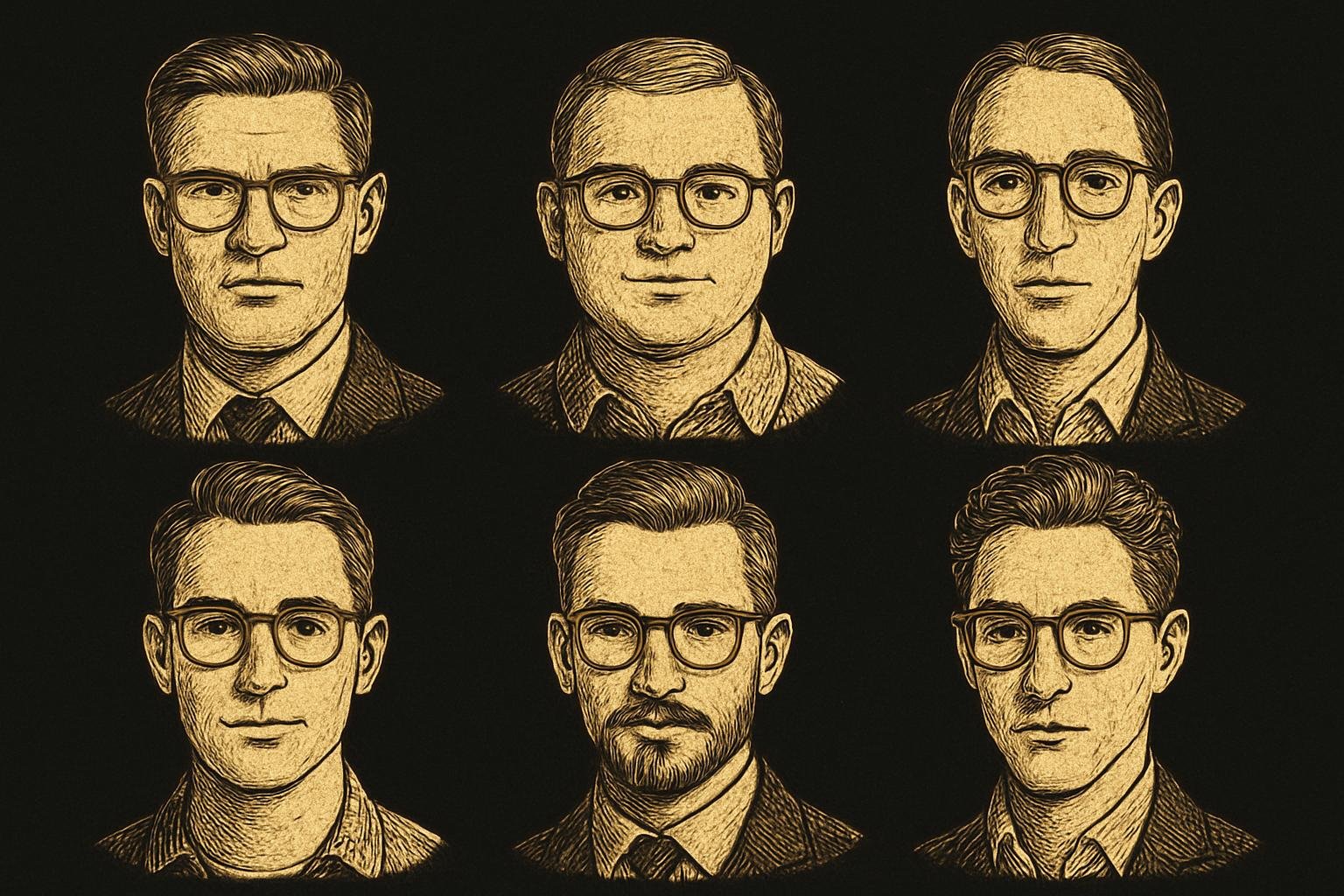
Forget the internet quizzes. You only need to notice two things: where you’re widest (forehead, cheekbones, or jaw) and whether your face is longer than it’s wide. Use a dry-erase marker on a bathroom mirror. Trace your outline, step back, and pick the closest pattern below. Then use the contrast rule to choose frames.
Square (strong jaw, similar width forehead-to-jaw)
- What to add: curves. Round, oval, or softly rounded squares.
- Specs to try: lens width 50–54, bridge 17–20, lens height 36–42. Avoid super-boxy 90° corners.
Round (soft jaw, width ≈ height)
- What to add: angles. Rectangles, squared aviators, and D-frames with crisp edges.
- Specs to try: lens width 51–55, bridge 16–19, lens height 35–40. A slightly upswept outer corner sharpens the look.
Rectangle / Oblong (longer face, similar width)
- What to add: height and some curve. Taller lenses, clubmaster shapes, or rounded rectangles.
- Specs to try: lens height 40–45; avoid ultra-narrow top-to-bottom windows that make the face look longer.
Oval (balanced, softly tapered)
- What to add: structure or character. Most shapes work—pick based on vibe. Angular rectangles for sharp; round acetates for creative; aviators for classic.
- Specs to try: lens width 49–53, bridge 16–20. Keep width within the cheekbones.
Heart / Inverted triangle (wider forehead, narrower jaw)
- What to add: visual weight low and soft edges. Light metals, keyhole bridges, or bottom-rounded rectangles.
- Specs to try: medium widths 49–52, bridge 16–19. Avoid heavy top bars that exaggerate width up top.
Diamond (cheekbones widest, narrow forehead and chin)
- What to add: gentle curves and balanced width. Oval frames, teardrop aviators, or subtly upswept shapes.
- Specs to try: lens height 38–42 to open the eye area; avoid frames that are too narrow at the brow.
Hair and beard shape also change your face balance. Updating your cut can open up more frame options—see our guide to haircuts after 40.
If you want a second set of eyes, Suvant’s image audit scores your face balance and calls out exactly which frame shapes will soften or sharpen your lines.
Fit, size, and comfort: the numbers that matter
Most frames print three numbers inside an arm. Example: 52–18–145 (lens width – bridge – temple length, all in mm). Use these as a starting point, then trust how the frame sits on your face.
Lens width (48–56 mm for most men)
- Narrow faces: 48–50 mm. Average: 51–54 mm. Wider faces: 55–56 mm.
- Check pupil centering. If your pupils sit far inboard or outboard of center, change the lens width.
Bridge (15–22 mm common)
- If frames slide, the bridge is too wide or the pads need adjustment. If you get red marks fast, the bridge is too narrow or sitting too high.
- Acetate with a keyhole bridge can sit more naturally on a higher nose bridge without pinching the top.
Temple length (135–155 mm common)
- Temples should run straight for 2–3 cm past your ear before curving down. If the bend starts too early, you’ll get hot spots. If it starts too late, frames slip.
- Ask for a heat adjustment on acetate or a slight pad tweak on metal before declaring a frame a no-go.
Lens height and tasks
- General daily wear: 35–42 mm lens height keeps proportions balanced.
- If you use multifocal lenses, ask your optician if your chosen frame gives enough vertical room for your reading zone. As a rule of thumb, 38–44 mm works for many.
Three fit tests in five minutes
- Shake test: look down 30°, shake your head gently side to side. Frames should not launch forward.
- Smile test: big smile. If the frames ride up off your nose, the fit is too tight at the cheeks or the bridge sits too high.
- Red-mark test: wear for 10 minutes, take them off. Light impressions fade in a minute. Deep grooves mean you need an adjustment or different size.
Color, material, and finish that make you look sharp
Color does more than you think. It ties into your hair, skin, and wardrobe. Keep one neutral pair for daily wear, then add character with texture or hue when you want presence.
Colors that usually work
- Dark hair or high-contrast features: matte black, deep tortoise, navy, smoke crystal.
- Grey/silver hair: matte charcoal, brushed gunmetal, slate, cool tortoise.
- Light hair or low-contrast features: warm tortoise, moss, sand, mid-brown horn.
Want to go deeper on what flatters your skin tone and clothes? Read our guide to finding your colors.
Materials
- Acetate: bold presence, easy to heat-adjust. Good for everyday or a statement pair.
- Titanium/stainless: light, durable, lower profile. Great for dress or long screen days.
- Combo (browline/clubmaster): structure up top, lightness below—good if your forehead is narrow.
Finish matters in real life and photos
- Pick matte or satin frames to reduce hotspots on camera.
- Ask for anti-reflective (AR) lenses. AR cuts reflections from screens and streetlights and helps your eyes read clearly in photos.
- If you’re often outdoors, discuss lens tints and transitions with your optician. For portraits, clear lenses with AR photograph cleanest.
When you want an honest read on whether a bolder color helps or overwhelms you, the Suvant audit flags where your frame color is helping your presence or muddying it—and suggests cleaner alternatives.
A small rotation that covers your life
You don’t need a drawer full of frames. Two or three options cover 99% of your week and give you range for work, dates, and weekends.
The simple three
- Everyday neutral: mid-width matte acetate rectangle with softened edges (e.g., 51–53 / 17–19 / 145). Wear to work, errands, casual nights.
- Character pair: round or P3 acetate in tortoise or smoke crystal (49–51 / 19–21 / 145). Wear for dinners, creative settings, or when your outfit is simple.
- Lightwire/dress: brushed titanium rectangle or teardrop aviator (50–52 / adjustable pads). Wear with tailoring or when you want minimal weight.
What to say in the shop
- “I’m aiming for frames whose total width matches my cheekbones within five millimeters.”
- “Show me a rounded option to soften my jaw, and a more angular option for sharper days.”
- “Matte or satin finishes only, with AR lenses.”
- “Let’s check pupil centering and do a quick pad/temple adjustment before I decide.”
Budgeting (categories, not brands)
- Acetate daily driver: expect fair quality in the mid-range. Look for solid hinges and even polishing.
- Titanium wire: pay for comfort and durability. Feather-light and adjustable is the point.
- Backup pair: if you’re hard on glasses, consider a second neutral in a slightly different shape.
Want your frames, haircut, and photos to all tell the same story? Suvant turns an honest photo audit into exact next steps—barber briefs, wardrobe moves, and photo fixes—in one plan.
Photos and glare: how to keep your eyes visible
Glasses don’t have to ruin photos. Control reflections and you’ll look present and clear on camera, from headshots to dating apps.
Before the shoot
- Clean everything: wash and dry your hands; use a microfiber cloth and lens spray. Oils cause flare.
- Use AR lenses: ask your optician for high-quality anti-reflective coating. It won’t remove every reflection, but it reduces the bright streaks that hide your eyes.
- Choose matte/satin frames: high-gloss acetate and polished metal pick up highlights.
During the shot
- Light angle: avoid a light source directly in front of you at eye level. Raise lights above eye line or move them 30–45° off-axis.
- Head angle: a 5–10° downward tilt or a slight turn left/right bounces glare away from the lens without looking posed.
- Nose pad tweak: if you wear metal frames, a tiny downward angle on the front can kick reflections down. Ask a pro to adjust—don’t bend them hard yourself.
- Avoid ring lights: they leave perfect circles in lenses. Use a soft window or lamp bounced off a wall.
On dating apps
- Get at least one clear shot without reflections, one with your everyday frames, and one wider shot where the temples don’t cut through your eyes.
- Skip thick, high-gloss frames in your lead photo if they dominate your face. A lighter, matte pair often reads more open.
- For more photo help, here’s how to set up shots that work: dating profile photos after 40.
Your try-on plan for this weekend
Block one hour. Go to two shops. Try 8–12 frames total. Take clear photos and make a decision within 48 hours so you don’t overthink it.
Step-by-step
- Measure at home (5 minutes): note your cheekbone width in the mirror and write it down. Decide if your lines read square, round, long, or balanced.
- Shop 1 (25 minutes): ask for 3 shapes that contrast your lines and 1 that matches your current style. Pull two sizes of each, within the width rule.
- Photos (5 minutes): take front, slight angle, and profile shots in window light. Clean lenses first.
- Shop 2 (20 minutes): repeat with a different brand mix. Focus on comfort and finish.
- Decide (within 48 hours): compare photos on a big screen. Eliminate anything that slides, pinches, or glares excessively. Pick one neutral and, if budget allows, one character pair.
What to capture in your notes
- Model and size numbers (e.g., 51–19–145) and estimated total width.
- How the bridge felt after 10 minutes.
- Whether your pupils centered and if your brows were visible.
- Any glare issues under typical indoor light.
Round out your look with a haircut that supports the frame line. If you’re deciding between rounded and angular frames, a cleaner, tapered cut can open up both options—see our haircut guide for exact barber language.
Get the honest audit you've never gotten.
Three photos, eight scores, the real reasons behind each number, then a ranked plan to fix them one move at a time.
Get my free audit →