A Grown Man’s Guide to Pant Fit After 40
- Use a five-point check—rise, seat, thigh, taper, break—to judge any pair in under a minute.
- Jeans can fit closer than chinos; dress trousers need more room and drape.
- The waistband sits where your core is stable: usually navel to two fingers below.
- Most fit issues are one quick alteration: hem, taper from knee down, or waist nip.
- Buy for the seat and thigh first; tailor the waist and length second.
The 60-second fit check (answer first)
You’re over 40. You want pants that look sharp without feeling tight. Use these five checkpoints in a mirror with good light. Bend, sit, and walk 20 steps before you decide.
- Rise (where the waistband sits): Aim for mid to high rise. The top of the waistband should land between your navel and two fingers below it. When you sit, no belt-buckle dive or rear exposure.
- Seat (butt and back yoke): Smooth across the back with no horizontal stress lines. You should be able to pinch about 0.5–1 inch of fabric at the fullest part of the seat. No sagging fabric puddles under the cheeks.
- Thigh: Comfort first. You want a clean line that doesn’t grab your quad. Pinch test: standing, you can pinch 0.5–1 inch of fabric at mid-thigh. If you see vertical pull lines, size up.
- Taper (knee to ankle): Calf should not feel hugged. From knee down, the leg should narrow slightly so the opening just kisses your shoe without swallowing it. A simple tailor taper can fix a tube-like leg.
- Break (pant meets shoe): Everyday: a slight break—one small horizontal crease at the front. Casual clean look: no break. Classic/suited: slight to full break depending on shoe bulk and formality.
Buy the pair that fits best in the seat and thigh. Then tailor the waist and hem. That order saves you returns and buyer’s remorse.
Related reading: if denim is your main rotation, see our jeans guide for men over 40.
Understand the anatomy: rise, seat, thigh, taper, break
Once you know what each area should do, you stop guessing. Here’s how each panel should look and feel, plus what a tailor can do if it’s close but not right.
Rise
- Checkpoint: Waistband lands at or slightly below your navel. Your belt runs level—no V-shape droop at the front.
- Move test: Sit, then stand. If you need to yank them up after, the rise is too low.
- Tailor reality: Rise cannot be raised on finished pants. If rise is off, choose a different model.
Seat
- Checkpoint: Back view is smooth. No smile lines (curving stress creases under the cheeks). No extra hammock fabric.
- Pinch: 0.5–1 inch at the widest point. Less = too tight. More = sagging.
- Tailor reality: A seat take-in is possible but limited. Choose the pair that’s 90% there in the seat.
Thigh
- Checkpoint: Straight standing, you can slide a flat hand down the front of your thigh without snagging.
- Pinch: 0.5–1 inch of give. Athletic thighs may need a relaxed thigh with a smart taper below the knee.
- Tailor reality: Letting out the thigh is limited by seam allowance. If quads are tight, size up and taper the lower leg.
Taper
- Checkpoint: Natural narrowing from knee to ankle. Hem opening usually 6.5–7.5 inches (measured flat) for most medium builds; adjust up or down 0.5 inch based on shoe size and calf.
- Tailor reality: Easy fix. Ask for a knee-down taper that preserves drape in the thigh.
Break
- No break: Hem hovers, no crease. Clean and modern with sleek sneakers or loafers.
- Slight break: One small crease at the front. Versatile for work and evenings.
- Full break: Two or more creases. Classic, best with chunkier shoes or traditional suits.
- Tailor reality: Simple hem. Decide cuffs first: cuffs eat 1.5–2 inches of length.
Scripts for your tailor:
- “Hem to a slight break with no back heel drag. Keep the back 0.25 inch longer than the front.”
- “Taper knee to hem so the opening is 7 inches flat. Do not touch the thigh.”
- “Take the waist in 1 inch. Keep the seat room; no pulling across the back.”
Jeans fit after 40: durable, clean, not tight
Denim is forgiving, but heavy fabric can create bulk if the pattern is off. Aim for a mid to high rise, comfortable thigh, and a gentle taper that suits your shoe rotation.
- Rise: Mid to high. Low-rise jeans fight your posture and create a belly shelf when you sit.
- Seat: Look for a yoke that follows your back curve. A gap at the waistband means a bigger seat than your waist—plan to nip the waist 1–1.5 inches.
- Thigh: Because denim relaxes, start snug-but-not-tight. You should still pinch 0.5 inch.
- Taper: Versatile opening is 6.75–7.25 inches flat for most average sizes. Boots may want 7.5–8 inches to avoid snagging.
- Break: Casual clean: no break or a light graze on the shoe. If you cuff, add a 1–2 inch single cuff; keep the inside clean and even.
Try-on flow:
- Sit for 30 seconds. If the waistband bites, the rise or waist is wrong.
- Walk 20 steps and do a knee lift. If the thigh grabs, size up or try an athletic taper.
- Check calf. If the fabric sticks to your calf, ask for a different cut or plan a knee-down taper.
Alteration plays:
- Hem with chain stitch if you want original denim look. Tell the shop: “No break, no back drag. Keep 0.25 inch back drop.”
- Waist nip up to ~1.5 inches is common. More than that can distort pockets—consider a different size.
Want outfits that make jeans look intentional, not default? See smart-casual outfit ideas for men over 40.
Chinos fit for work and weekend
Chinos don’t stretch like denim. Err on comfort in the thigh with a clean taper below the knee. The goal is structure without stiffness.
- Rise: Mid rise is your friend. The waistband should meet a tucked shirt without gapping.
- Seat: Smooth back, no V-shaped stress under the pockets. If the seat is close, prioritize it—you can take in the waist easily.
- Thigh: Slightly more room than jeans. You still want only 0.5–1 inch of pinch. Too much and the leg collapses; too little and you’ll get whiskers when you sit.
- Taper: Aim for a subtle V from knee to hem. Hem opening around 7–7.5 inches flat keeps them modern without “skinny.”
- Break: Slight break for the office. No break for a crisper look with sneakers or loafers.
Details that matter:
- Pocket flare: If front pockets flare open, the thigh or hip is too tight. Size up, then tailor the waist.
- Fabric weight: 7–9 oz chinos drape lighter and show fewer knee bulges. Heavier twills hold a crease but feel warmer.
- Cuffs: A 1.5-inch cuff adds weight and helps the hem hang straight; choose it if your calves push fabric forward.
Tailor scripts:
- “Hem to slight break with a 1.5-inch cuff. Back hem 0.25 inch longer.”
- “Taper knee to hem by 0.5 inch total. Leave thigh alone.”
- “Take the waist in 0.75 inch. Keep pocket openings flat.”
Also skim common style mistakes over 40 to avoid easy chino pitfalls like low-rise and puddled hems.
Dress trousers: drape, not squeeze
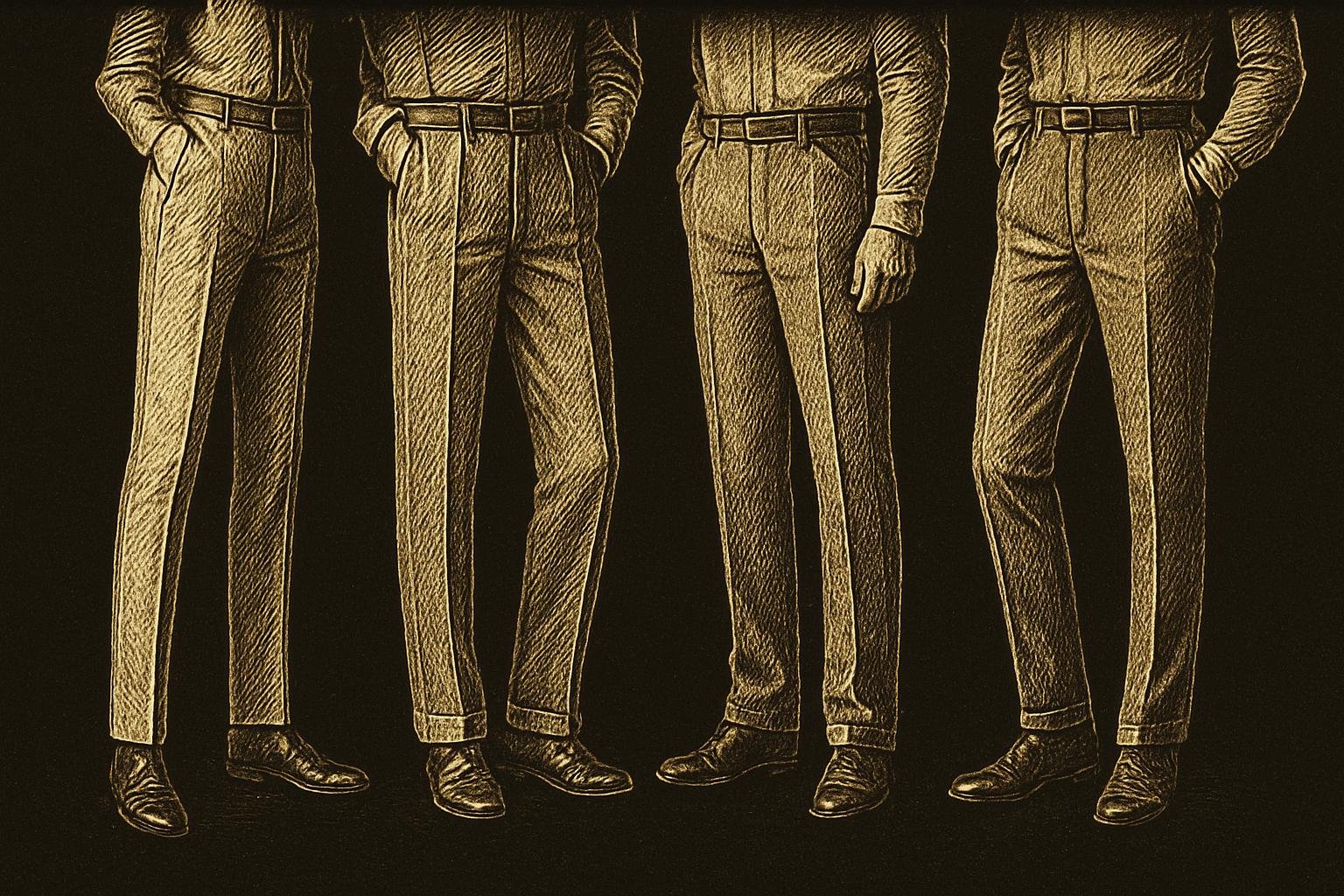
Suit and dress trousers should float off your frame. The fabric needs room to drape, so you’ll allow a touch more ease than with denim or chinos.
- Rise: Mid-high rise works with a tucked dress shirt and jacket. Waistband should meet the narrowest stable point of your torso.
- Seat: Aim for smooth, lightly skimming. Pinch 0.75–1.25 inches at the seat—more ease than jeans.
- Thigh: Pinch 0.75–1.25 inches at mid-thigh. A clean fall from hip to knee with no grab when you sit.
- Taper: Gentle. Opening 7–8 inches flat depending on shoe. Too tight and you’ll get shin cling and break chaos.
- Break: Slight break is the default. If you prefer a sharp modern line, go no break with a precisely set hem and, optionally, a 1.5–2 inch cuff for weight.
Pleats and cuffs:
- Single pleat: Adds comfort in the rise/hip. Choose it if you sit long hours or have athletic thighs.
- Flat front: Clean, minimal. Demands a spot-on rise and thigh to avoid whiskers.
- Cuffs: Traditional with pleats; help the hem hang straight.
Tailor scripts:
- “Set hem to slight break with a 1.75-inch cuff. Make back hem 0.25 inch longer.”
- “Shape knee to hem subtly; leave thigh ease for drape.”
- “Take the waist in 1 inch through the center back seam. Keep seat shape; no pulling at back pockets.”
Common fit mistakes after 40—and quick fixes
- Mistake: Low-rise waistband under the belly.
Fix: Choose a mid/high-rise pattern. If the waist fits but slides, ask for side-adjusters or rely on a snug belt, but start with the right rise. - Mistake: Tight thigh causing pocket flare and whiskers.
Fix: Size up one in the waist/thigh, then take the waist in 0.75–1 inch. - Mistake: Tube leg that stacks on the shoe.
Fix: Taper knee to hem and hem to slight break. Say: “7-inch opening flat, slight break.” - Mistake: Calf cling on slimmer cuts.
Fix: Choose cuts labeled athletic/roomy thigh with taper, or increase hem opening by 0.25–0.5 inch. - Mistake: Puddled hems dragging at the back.
Fix: Hem so the back just clears the top of the heel counter. Slight break up front, zero drag in back. - Mistake: Waist gap at the back.
Fix: Center-back take-in of 1 inch. Keep darts balanced so back pockets stay flat. - Mistake: Over-tapered dress pants.
Fix: Restore 0.25–0.5 inch of width from knee to hem for drape. Dress fabric needs air to move.
If you want outside eyes before you buy, Suvant offers a fast, honest image audit. Upload three photos and you’ll see how your pants fit across rise, drape, length, and proportion, plus exact next steps. The audit is free at the web app and takes about two minutes; the full plan with quests is $89/yr with a money-back guarantee.
How to try on, buy, and alter—like a pro
Most “bad fit” is solved by process. Here’s a zero-ego way to shop and leave with pants that work on your body right now.
Before you go
- Wear the shoes you’ll pair with the pants. Hem depends on shoe height.
- Bring a belt you actually use (1–1.5 inches wide for casual; 1–1.25 for dress). If you’re rethinking belts, bookmark how to match belt and shoes.
- Wear close-fitting underwear. Bulky boxers skew the seat test.
In the fitting room
- Try two adjacent sizes and, if offered, two rises in the same model.
- Run the five-point check: rise, seat, thigh, taper, break.
- Sit for 30 seconds. Walk 20 steps. Do a shallow squat. Anything bites or tugs? Reject.
- Pick the pair that nails seat and thigh. That’s your base for tailoring.
At the tailor
- Hems: Decide cuff vs no cuff first. Typical lead time: 2–5 days. Bring the shoes.
- Waist: Common take-in: up to 1–1.5 inches. Beyond that, choose another size.
- Knee-down taper: Smooth the line, don’t chase tightness. Ask for a chalk try-on before they sew.
What to say, word-for-word:
- “These fit in the seat and thigh. Please hem to a slight break with the back 0.25 inch longer.”
- “Take the waist in one inch through the center back. Leave room in the seat.”
- “Taper from knee to hem so the opening is 7 inches flat. No change above the knee.”
Maintenance check: After 10 wears, reassess the hem and waist. Denim relaxes; dress wool may drop slightly. Minor tweaks keep the silhouette sharp.
If you like structure and simple steps, Suvant’s audit turns this into a ranked quest list with exact deliverables, like a barber-level brief for your tailor (measurements, target break, taper notes). It’s all in the web app at app.getsuvant.com.
Get the honest audit you've never gotten.
Three photos, eight scores, the real reasons behind each number, then a ranked plan to fix them one move at a time.
Get my free audit →